
Gynecological Exams / Tests
Vaginal Culture
What it can and cannot do
A culture grows the organism and names it. This is how Candida albicans is told apart from non-albicans species. When the species changes, the choice of medicine may change. Group B streptococcus screening near the end of pregnancy is also a culture; that sample is taken not from the vagina alone, but from the vagina and the rectal opening. Merging the two into one container leads to the wrong preparation.
Culture is not the standard screening test for chlamydia and gonorrhoea. These are tested with nucleic acid tests and are covered on the sexually transmitted infection pages. Trichomonas, too, is detected better in most panels by antigen or nucleic acid testing. Growth in culture is not a diagnostic criterion for bacterial vaginosis. Growth of lactobacilli from the normal flora does not mean disease.
| Question | First tool | Role of culture |
|---|---|---|
| First-time itching, cottage-cheese-like discharge | Examination, pH, microscopy | If microscopy is negative or it recurs |
| Thrush three or more times a year | Identifying the species | This is its main job |
| Same discharge once the medicine is finished | Species and, if needed, susceptibility | Suspected non-albicans species |
| Bad smell, grey discharge | Amsel or equivalent | Culture does not diagnose it |
| Suspected chlamydia or gonorrhoea | Nucleic acid test | Not covered by this page |
| Pregnant, carrier status near birth | Vaginal and rectal culture | Group B streptococcus |
In recurrent thrush
In uncomplicated thrush, a short course of a vaginal azole is usually enough. Three or more confirmed episodes a year, a severe picture, or symptoms that persist after the medicine is finished count as complicated. The CDC recommends a culture or species identification in this group. The aim is to detect non-albicans Candida and azole treatment that is being extended for no reason.
Candida growing in a culture does not on its own mean a yeast infection. In some women without symptoms, Candida lives in the vagina as a resident. The CDC puts this share at roughly 10–20 percent. Without itching, burning or discharge, growth alone does not lead to a prescription. A prescription depends on symptoms and growth being present in the same woman.
How the sample is taken
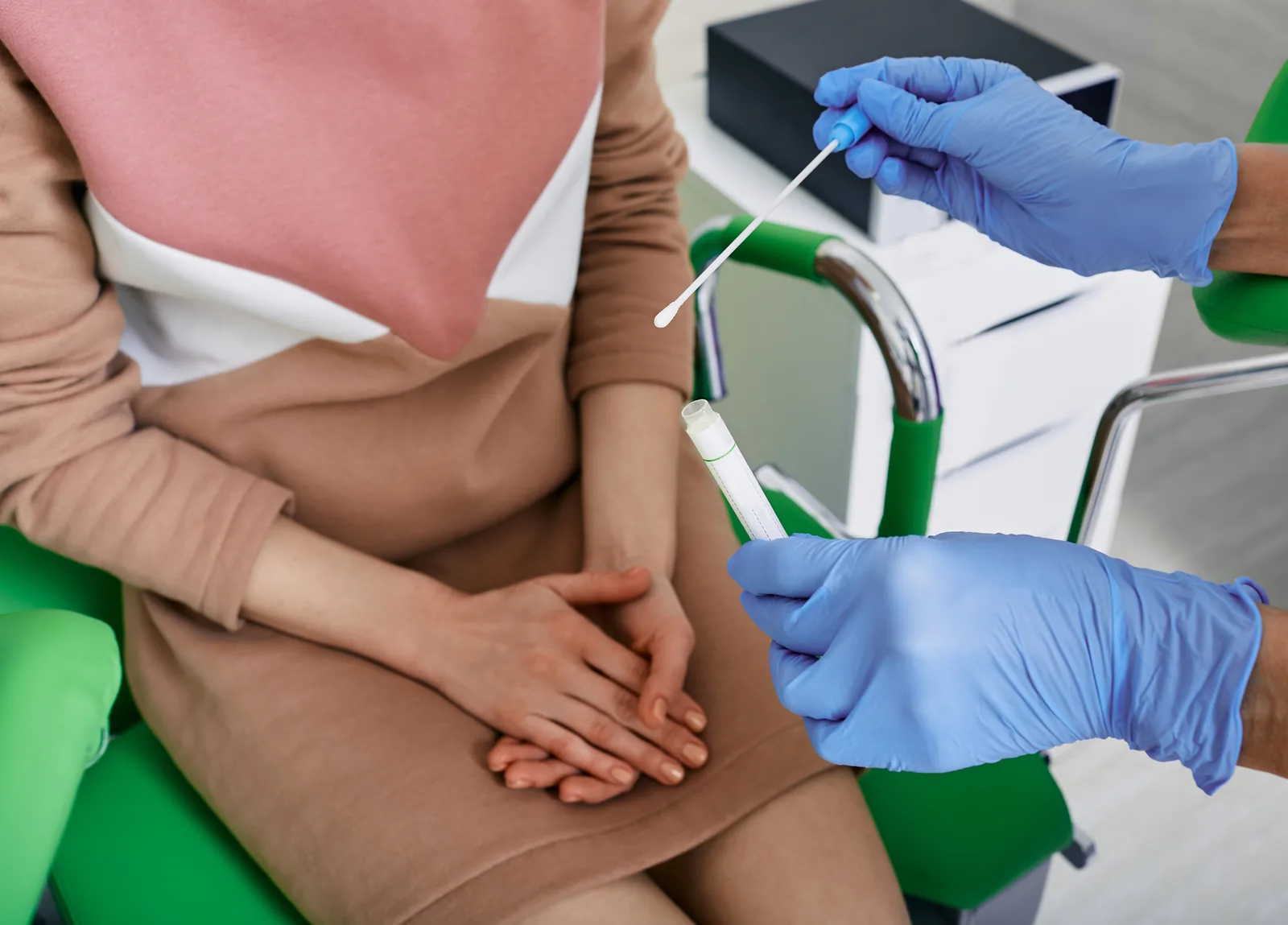
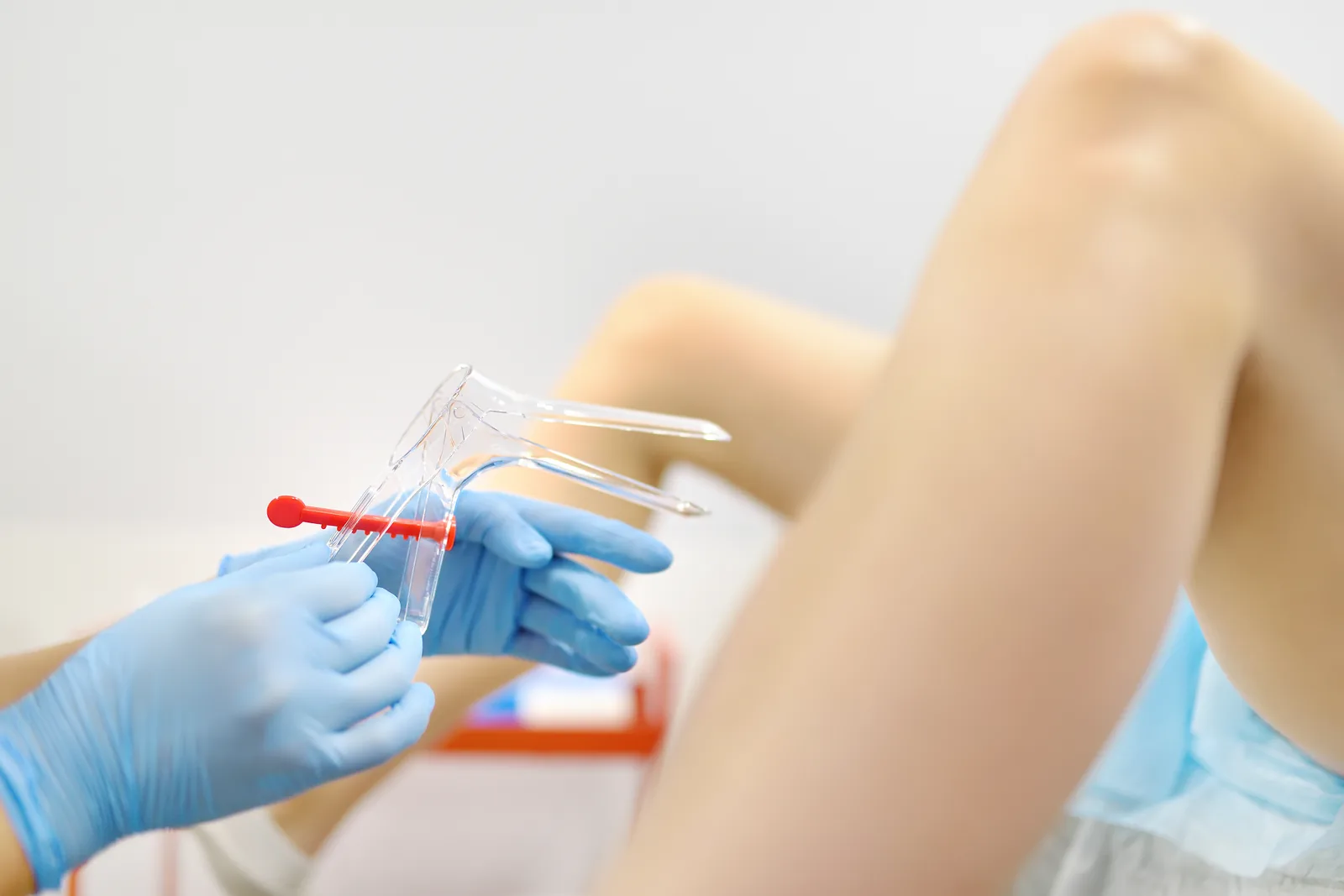
Using a speculum, a swab is taken from the side wall of the vagina or the fornix. The cervical canal is not the target of this container; cervical samples belong to the smear and chlamydia tests. Glove gel can spoil some growth media, so the swab is taken with a gel-free tip. The day of the period, antibiotics, vaginal creams and the timing of intercourse are written on the request form. Creams and pessaries should be stopped at least two to three days before the sample. Otherwise the result may come back as “no growth”.
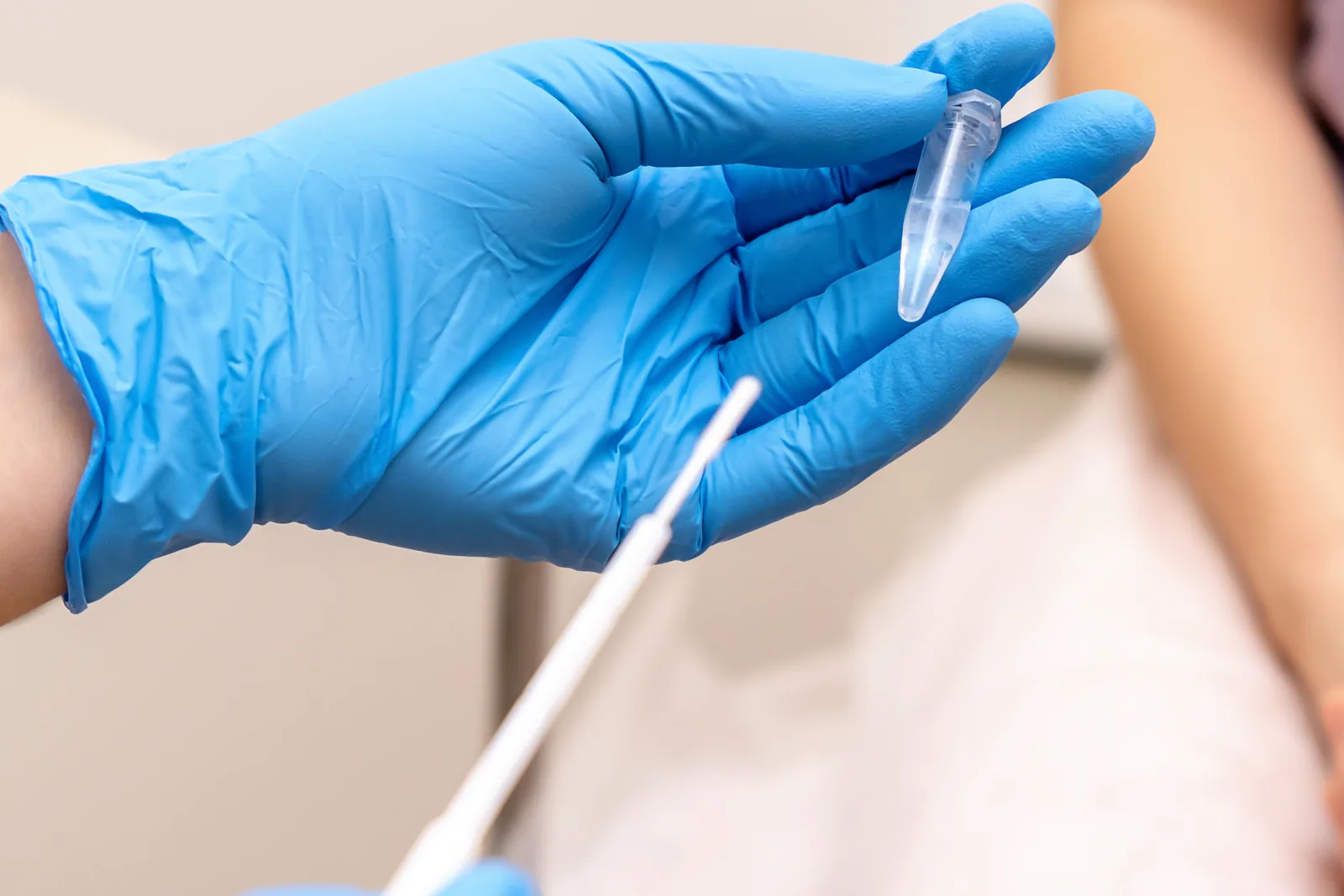
The container is sealed at the clinic and sent to the partner laboratory. It is not a test with an on-site result like a blood count. It takes a few days, depending on the medium and the species. Susceptibility testing is not added automatically to every organism that grows. It can be requested for non-albicans species, recurrent episodes or treatment failure.
How is the sample taken? (animation)
Loading animation…
- A sterile swab is guided to the upper part of the vagina, rotated to collect the sample, and withdrawn.
- The swab is placed in a transport tube; the tube is sealed at the clinic and sent to the contracted laboratory.
This is an illustrative animation. In reality, the sample is taken from the side wall of the vagina or from the fornix during a speculum examination. The colonies and disc sizes do not represent any specific microorganism.
How to read the result
| Report line | What it means |
|---|---|
| Normal flora, no growth | No disease-causing organism grew in this container; if symptoms persist, another test is needed |
| Candida albicans | The species is known; if there are symptoms, treatment is discussed |
| Candida glabrata or non-albicans | Response to azoles may be weak; the regimen changes |
| Gardnerella or mixed growth | Not a diagnosis of bacterial vaginosis on its own |
| Group B streptococcus, pregnant | Antibiotics are discussed in the birth plan |
| Candida without symptoms | May be carriage; treatment is not required |
The result may appear in the portal as plain data. Interpretation happens at the consultation. If an earlier culture from another centre names the species, it goes into your file; its treatment is not taken over.
What happens in the laboratory? (animation)
Loading animation…
- The sample is streaked onto a culture-medium plate in a zigzag pattern.
- The plate is closed and placed in the incubator; time is allowed for the microorganisms to grow.
- After incubation, the colonies that have formed on the plate are examined and the species is identified.
- If needed, a susceptibility test (antibiogram) is performed: the clear zone around a disc shows the drug's effect, while no clear zone at all means resistance.
This is an illustrative animation. In reality, the sample is taken from the side wall of the vagina or from the fornix during a speculum examination. The colonies and disc sizes do not represent any specific microorganism.
Pregnancy
In a pregnant woman with suspected thrush, oral fluconazole is not routine. If treatment is discussed, it stays within vaginal azole therapy. A culture is taken if the species needs to be identified; not every discharge in pregnancy needs one. Group B streptococcus screening near birth is a separate request. A positive result changes the antibiotic plan during labour in that pregnancy. It gives no guarantee for the next pregnancy.
Our approach at SoftCare
Vaginal culture is the discharge entry on our laboratory page. The sample is taken at the clinic, and the culture is done at a partner laboratory. We do not present culture as a must for a first discharge. Recurrent thrush, itching with negative microscopy and symptoms that persist after the medicine is finished are where this test belongs. Chlamydia, gonorrhoea and syphilis are separate tests. Without symptoms, growth does not lead to a prescription. The result is read with the doctor.
Frequently asked questions
Does every discharge need a culture?
No. The first look is an examination and microscopy.
Do I need to fast?
No. Vaginal creams and pessaries are stopped before the sample.
Can it be taken during my period?
Heavy bleeding contaminates the growth. If possible, it is taken once the bleeding has stopped.
How many days until the result?
A few days. Species identification and susceptibility can make it longer.
Something grew. Do I definitely need medicine?
Without symptoms, Candida growth is not a reason to treat.
Does a culture show chlamydia?
No. That is a separate test.
Can it be taken during pregnancy?
Yes, if the species needs to be identified. Streptococcus screening near birth is a separate request.
Does a negative culture rule out disease?
It rules out what this test looks for. If symptoms persist, another cause is sought.
Listing these sources does not mean SoftCare is the laboratory that runs the culture.
References
- Vulvovaginal Candidiasis — STI Treatment Guidelines, 2021. Centers for Disease Control and Prevention (CDC), 2021.
- Testing and Diagnosis for Candidiasis. Centers for Disease Control and Prevention (CDC), 2024.
- Practice Bulletin No. 215: Vaginitis in Nonpregnant Patients. American College of Obstetricians and Gynecologists (ACOG). Obstetrics & Gynecology 135(1), 2020.
- Committee Opinion No. 797: Prevention of Group B Streptococcal Early-Onset Disease in Newborns. American College of Obstetricians and Gynecologists (ACOG). Obstetrics & Gynecology 135(2), 2020.
Medically reviewed by Op. Dr. Şükrü Sanus, Obstetrician & Gynecologist · Last medical review: