
Gynecological Exams / Tests
Colposcopy
Screening and colposcopy are not the same thing
In Türkiye, national cervical screening is an HPV-DNA sample every five years between the ages of 30 and 65. If HPV is negative, the interval is long. If HPV is positive, it is read together with a smear. Colposcopy is not the name of this screening sample. Screening tells us who needs a closer look. Colposcopy takes that close look at a cervix where a concern has come up.
ASCCP 2019 does not base the decision on a single result line. It bases it on the CIN 3 risk given by today’s test together with past smears, past HPV results and past biopsies. The same smear wording can mean follow-up in a woman with a clean history and colposcopy in a woman with an abnormal history. That is why an appointment is not booked as “let’s look right away” before old reports are requested.
When it is considered
| Result | Role of colposcopy |
|---|---|
| HPV 16 or 18 positive | Most algorithms look without waiting for the smear |
| High-risk HPV and abnormal smear | Examination and biopsy if needed |
| HSIL, ASC-H, AGC | High risk; colposcopy is not delayed |
| ASC-US and HPV positive | Colposcopy or a check-up, depending on history |
| LSIL, previous HPV negative | Test in one year, not immediately for everyone |
| HPV negative, smear normal | No colposcopy; routine screening interval |
| Cervix looks suspicious, bleeding after contact | Examination without waiting for the smear result |
Bleeding after contact, foul-smelling discharge and a visible ulcer do not wait for screening age. This is a matter for examination before colposcopy. In a pregnant woman, a high-risk result is not postponed; the reasons for biopsy are narrowed, and treatment is usually left until after the postpartum period.
What the procedure is like
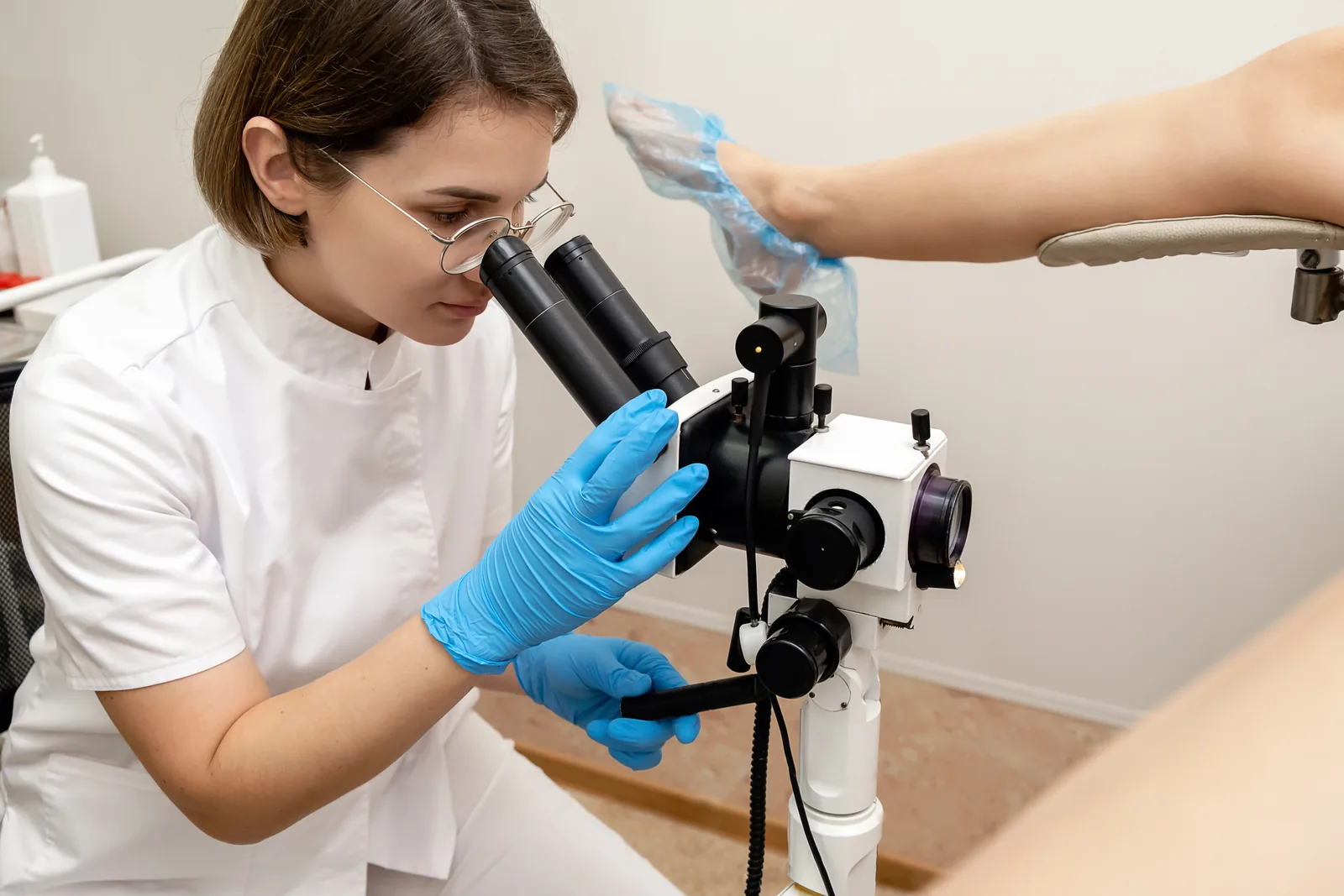
A speculum is inserted. The cervix is wiped with saline, then dilute acetic acid is applied. Abnormal epithelium turns white within a minute or two. This whiteness is not a sign of cancer. The vessel pattern is recorded, and whether the whole transformation zone could be seen. If the transformation zone lies inside the canal, the examination counts as incomplete. Lugol is added in some examinations; it is not needed every time.
For most women it takes ten to twenty minutes. The cramping is similar to period pain. If a biopsy is taken, there is a brief sting. The procedure involves no radiation, and anaesthesia is not routine. If your pain threshold is low, local numbing can be discussed. Some bleeding is expected; a panty liner is enough. Sex, swimming pools and vaginal creams are not advised for a few days. Heavy bleeding, fever or a bad smell should be checked the same day.

A biopsy is not taken at every examination
The ASCCP colposcopy standard says that any area turning white with acetic acid may be sampled. In a woman whose cervix looks completely normal, with no HPV 16 or 18 and no HSIL, a random biopsy is not required. If there is a suspicious area, two to four small pieces are usual. The piece is not taken to weaken the cervix, but to record the grade.
Pathology comes back as CIN 1, CIN 2 or CIN 3. What each grade means and what happens next is explained on the CIN 1-2-3 page. Even if the colposcopy report is closed as “normal”, the follow-up test is not dropped if HPV persists. The image does not clear the virus.

Going for colposcopy: patient information card
A 2-page card explaining what happens before, during and after the procedure (PDF, A4).
How to read the result
| Wording | What it means |
|---|---|
| Adequate colposcopy | The whole transformation zone was seen |
| Inadequate | Something inside the canal may have been missed; an extra sample is discussed |
| Acetowhite area | Suspicious epithelium; it does not mean cancer |
| No biopsy | The image is clean and the risk is low |
| CIN 1 | Low grade; usually monitored |
| CIN 2 or 3 | Treatment threshold; weighed with age and pregnancy plans |
What it does not show
Colposcopy does not replace the HPV vaccine. The vaccine does not replace screening either. It does not show the inside of the uterus, the ovaries or the endometrium. It does not answer the yeast question that a vaginal culture asks. A negative colposcopy does not make the HPV test a year later unnecessary. The procedure is not presented as a cause of infertility. Deep conization is a separate operation and is not what this page offers.
Our approach at SoftCare
Colposcopy is the next step after the smear and HPV page, not a replacement for it. We do not book a same-day examination without asking for old reports. HPV 16 and 18 and a high-grade smear are not delayed. A low-risk result can be left until one year later. If a biopsy is taken, the tissue goes to a partner pathology laboratory. The result is read by CIN grade; treatment is not started on the words “there was whiteness”. In a pregnant woman the examination is not postponed, and treatment is usually left until after birth.
Frequently asked questions
Does colposcopy replace the smear?
No. Smear and HPV tell us who needs a closer look.
Does everyone with positive HPV need colposcopy?
No. The type, the smear and your history change the decision.
Is it painful?
There may be cramping. A biopsy causes a brief sting.
Is it a cancer diagnosis?
No. It picks out the suspicious area. The diagnosis comes from the biopsy.
Can it be done during my period?
Heavy bleeding hides the view. Light spotting may not be a problem.
Do I have to avoid sex?
For a few days if a biopsy was taken.
It was normal. Is the HPV gone?
No. The follow-up test is not dropped.
Can it be done in pregnancy?
Yes, if the result is high-risk. Treatment is usually left until after the postpartum period.
Listing these sources does not mean SoftCare wrote those texts. Pathology samples are read at a partner laboratory.
References
- 2019 ASCCP Risk-Based Management Consensus Guidelines for Abnormal Cervical Cancer Screening Tests and Cancer Precursors. Perkins RB, Guido RS, Castle PE, et al. Journal of Lower Genital Tract Disease 24(2), 2020.
- ASCCP Colposcopy Standards: Risk-Based Colposcopy Practice. Wentzensen N, et al. Journal of Lower Genital Tract Disease 21(4), 2017.
- Kanser Taramaları (Ulusal Rahim Ağzı Kanseri Tarama Programı). T.C. Sağlık Bakanlığı, Halk Sağlığı Genel Müdürlüğü, 2026.
- Practice Bulletin No. 168: Cervical Cancer Screening and Prevention. American College of Obstetricians and Gynecologists (ACOG). Obstetrics & Gynecology 128(4), 2016.
Medically reviewed by Op. Dr. Şükrü Sanus, Obstetrician & Gynecologist · Last medical review: