
Gynecological Exams / Tests
Sexually Transmitted Infections

What this page brings together
This hub is not an advertisement for a single disease. When a woman comes with “discharge”, “a wart”, “burning” or “should I get tested?”, it shows her which door to take. Each agent’s route of transmission, symptoms, test and treatment are on its own page. Here you will find the shared rules: silent course, sampling, partner, pregnancy and follow-up testing.
Not every discharge is a sexually transmitted infection. Yeast infection and bacterial vaginosis can increase with sexual activity, but they are not on the classic list of strictly sexually transmitted agents. They belong on the discharge page. This hub does not absorb them.
Separate pages
The topics below are linked from this hub as they are published. A page that has not yet been written does not sit in the menu as a dead link.
Why symptoms are delayed in women
The cervix and urethra can carry an infection without pain. Chlamydia and gonorrhea may leave spotting after sex, bleeding between periods, or nothing at all. The first sore of syphilis is painless and heals on its own; that does not mean the disease is over. When a herpes blister heals, the virus does not disappear. Most HPV types do not cause warts and come up years later with a smear test.
Lower abdominal pain, fever and tenderness that worsens with movement suggest pelvic inflammatory disease. This is chlamydia or gonorrhea moving upwards. It is not just a discharge to be quickly dismissed. Even in women who are not pregnant, it can leave tubal damage and a risk of ectopic pregnancy.
Silent course (animation)
Loading…
- There are no symptoms, but the agent can move up from the cervix to the tubes; damage, pain and a warning sign appear in the tubes.
- Second part: with early testing and treatment, the agent is cleared.
This is an illustrative animation. Drawing: SoftCare Clinic uterus illustration. Tap to pause or resume.
Who should discuss testing
| Who | What is discussed |
|---|---|
| Under 25, sexually active | Chlamydia and gonorrhea once a year |
| Over 25, new partner or more than one partner | The same pair, as long as the risk continues |
| Discharge, burning, spotting | Identifying the agent; trichomoniasis is looked for in discharge |
| Pregnant, first visit | Syphilis and HIV; hepatitis B immunity |
| Wart or suspicious sore | Lesion page; a syphilis sore is not overlooked |
| Partner diagnosed | Test without waiting for symptoms |
| Three months after finishing treatment | Follow-up for chlamydia, gonorrhea and trichomoniasis |
The CDC recommends annual chlamydia and gonorrhea screening for sexually active women under 25. Over twenty-five, screening is discussed if there is a risk such as a new partner, more than one partner or an infection in the partner. Trichomoniasis is looked for in women who come with discharge. In Türkiye this table is not attached to every examination as a mandatory panel. Test orders are based on history and the pregnancy schedule.
Which test is right for me?
Loading…
- Select your age; in the top row, mark your situation: new partner, more than one partner, partner diagnosed, pregnancy.
- In the bottom row, mark your symptoms: discharge, burning, spotting, sore, wart, lower abdominal pain, fever.
- The tool shows the agents to discuss (CT chlamydia, NG gonorrhea, TV trichomoniasis, TP syphilis, HSV herpes, HPV, HIV, HBV hepatitis B) and the sample type (swab, blood, lesion).
- If lower abdominal pain comes with fever or spotting, a warning appears (suspected pelvic inflammatory disease). If there is only discharge and no risk, yeast infection or bacterial vaginosis is also considered.
This is not a decision tool; the doctor decides which tests to order.
When to test after exposure?
Loading…
- Select the number of days since exposure.
- For each agent, the dark band shows when the test starts to be meaningful, and the dashed line shows when symptoms may appear.
- The check mark on the right means the test is meaningful today; the clock symbol means you need to wait. There is no window test for HPV; the smear schedule applies.
The days are approximate values taken from international guidelines; the doctor decides according to the test type.
How the sample is taken
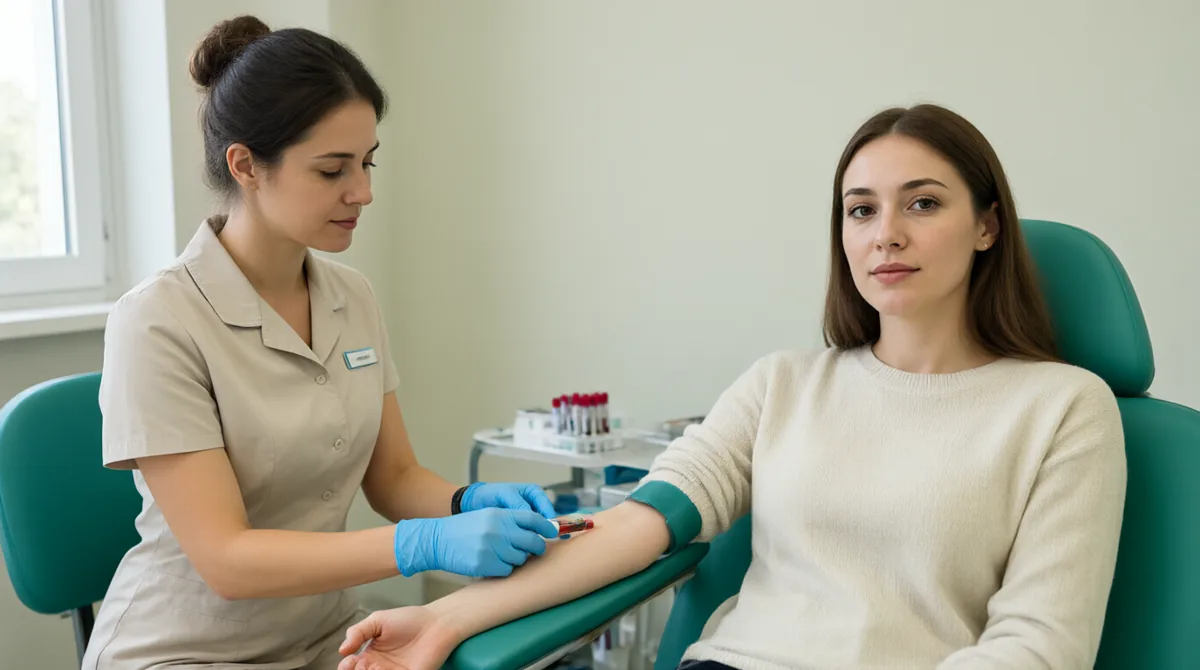
For chlamydia and gonorrhea in women, the preferred sample is a vaginal swab or a cervical swab. Urine is accepted in some panels; the timing of the period and of intercourse is noted for the laboratory. Syphilis and HIV are tested from blood. When herpes is suspected, a swab from an active blister does not ask the same question as a blood antibody test. For warts, HPV typing is not requested for every lesion.
The sample is taken at the clinic. Rapid card tests are not what this page offers. The result comes back from the partner laboratory. A positive result is discussed by phone and at the examination; a line in the portal does not start treatment on its own.
Partner and retesting
In chlamydia, gonorrhea, trichomoniasis and syphilis, informing the partner is part of the treatment. If a woman is cured and returns to the same partner without protection, she can be reinfected. Forcing the partner’s name into the file is not the purpose of this page. Notification runs separately for infections that have a legal framework. A follow-up test is discussed about three months after treatment ends. A test done too early may mistake dead bacteria for live ones.
Pregnancy
In pregnant women, syphilis and HIV screening is part of the first visit. Untreated syphilis passes to the baby. In HIV, transmission is greatly reduced with medication; the medication and delivery plan are not this clinic’s antiviral protocol, and a referral to the relevant centre is written. Genital warts can grow during pregnancy. If a herpes outbreak occurs around the time of delivery, the mode of delivery may change. These decisions are explained on the disease pages; here we only show the door.
Our approach at SoftCare
The hub does not replace the pages for each agent. The examination and sample are done at the clinic. In a woman who comes with discharge, yeast infection and bacterial vaginosis are not lumped onto the sexually transmitted list. Chlamydia and gonorrhea are not skipped because they are silent. Warts have their own page. For HIV and chronic hepatitis B there is testing and referral; we do not claim to be a treatment centre. Partner treatment and the three-month follow-up are the closing sentence of the prescription.
Appointments: +90 212 241 30 10 · softcareclinic.com
Sources
- Centers for Disease Control and Prevention. Sexually Transmitted Infections Treatment Guidelines, 2021. Screening age for chlamydia and gonorrhea in women, trichomoniasis and the framework for retesting after treatment.
- Workowski KA, et al. Sexually Transmitted Infections Treatment Guidelines, 2021. MMWR Recomm Rep. 2021;70(4):1–187.
- T.C. Sağlık Bakanlığı (Ministry of Health of Türkiye). Information framework on sexually transmitted infections. Silent course, syphilis and HIV in pregnant women, notification.
- American College of Obstetricians and Gynecologists. Chlamydia, gonorrhea, and syphilis. Committee opinion / practice advisory framework. Read together with screening in pregnancy.
Frequently asked questions
Do I need a test if I have no symptoms?
Age, a new partner and the pregnancy schedule do not wait for symptoms.
Is every discharge a sexually transmitted infection?
No. Yeast infection and bacterial vaginosis are assessed separately.
Does one test show everything?
No. Blood, swab and lesion are separate doors.
Is the partner treated too?
Yes, in chlamydia, gonorrhea, trichomoniasis and syphilis.
Does a condom prevent all of them?
It lowers the risk. HPV and herpes can spread through skin contact.
Are pregnant women tested?
Syphilis and HIV are discussed at the first visit.
Is HIV treated here?
No. Testing and referral are available.
Is there a check after treatment?
For chlamydia, gonorrhea and trichomoniasis, about three months later.
Listing a source does not mean SoftCare wrote that text or that it is an HIV treatment centre. Disease pages are published separately.
Medically reviewed by Op. Dr. Şükrü Sanus, Obstetrician & Gynecologist · Last medical review: