Abortion
Abortion Prices
The medical and legal facts that determine the fee — gestational week, previous births, C-sections, and other factors
The question of abortion price is usually the first thing on a woman's mind before she even calls a clinic. That is natural. Uncertainty makes an already difficult decision heavier. But the honest answer is this: there is no single figure. The reason you hear two different fees in the same city, even the same district, is not advertising — it is that the medical weight of the procedure differs from person to person.
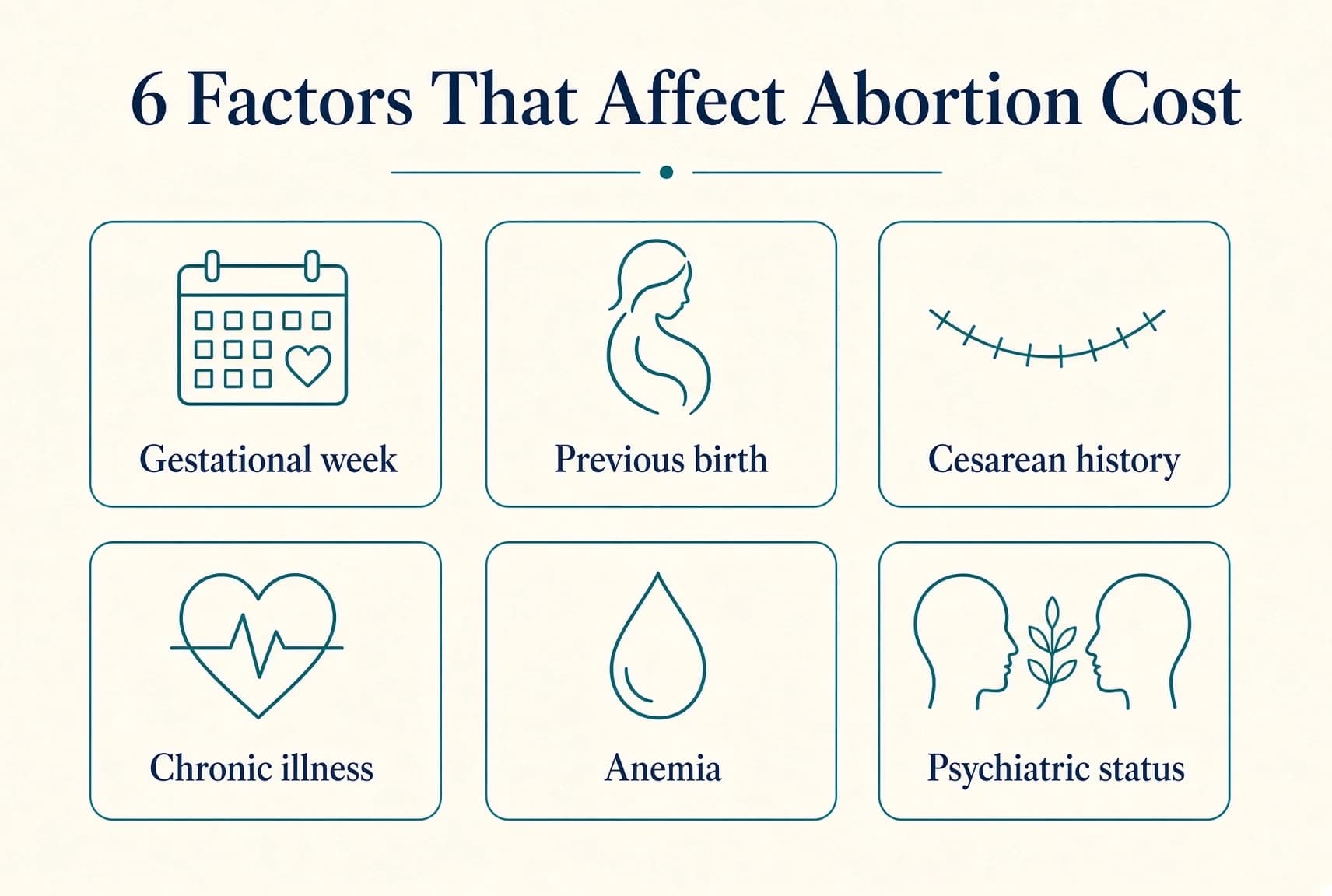
In practice, when abortion fees are discussed at private clinics in Turkey, the first thing looked at is the gestational week. A four-week pregnancy and a seven-to-eight-week pregnancy are not the same undertaking. A procedure approaching the tenth week is planned more carefully — both technically and legally — because it sits right before the legal limit. Alongside the week, previous birth history, the presence of a C-section, anemia, chronic illness, and psychiatric conditions also affect the price. Many centers do not ask about these thoroughly enough. Not asking does not make the procedure cheaper; it makes the risk invisible.
SoftCare Clinic's explanation of abortion pricing is clear, unexaggerated, and grounded in medicine. There is no fixed sticker price here. Instead, we explain why the fee varies, how the legal framework in Turkey limits the price, and what information needs to be prepared before the examination. The goal is to turn the question asked over the phone — "how much does it cost?" — into the right question: "How would this procedure be planned in my situation, and what does the fee include?"
Is abortion legal in Turkey, and why is the price discussed together with the legal limit?
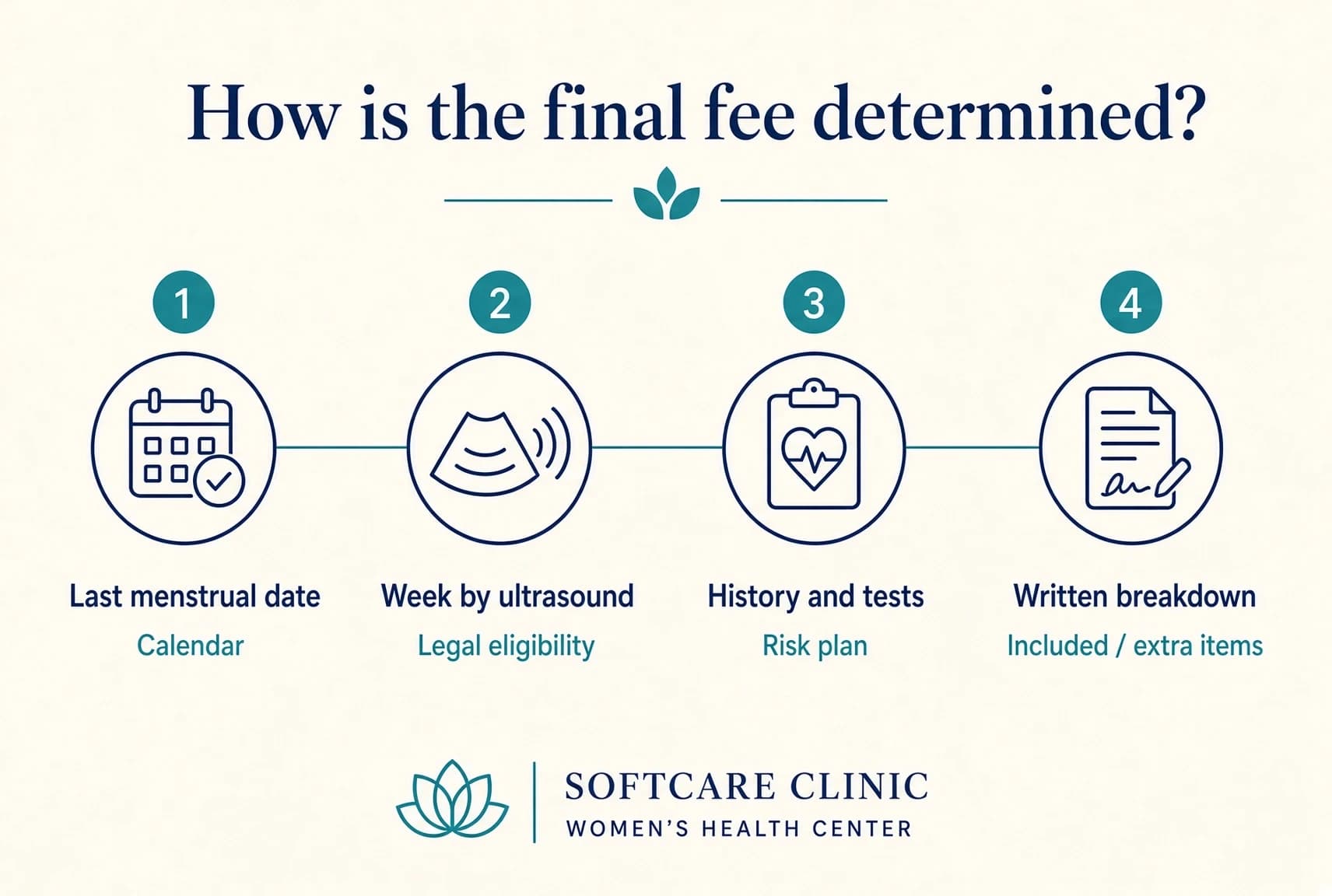
Elective termination of pregnancy is legal, under Article 5 of Population Planning Law No. 2827, until the completion of the tenth week of pregnancy. Contrary to a common public belief, this period is not calculated from the date of intercourse but from the first day of the last menstrual bleeding. Clinical confirmation is by ultrasound. It is common for there to be a difference between a woman's own calendar and the ultrasound week. For this reason, a pricing conversation does not conclude with the sentence "I think I'm five weeks along."
After completion of the tenth week, elective abortion cannot be performed. Beyond this point, pregnancy can only be terminated — with reports from the relevant specialists — in situations that threaten the mother's life or that would cause severe disability for the child to be born and future generations. Pregnancies resulting from sexual assault follow a separate legal path. This text explains the pricing logic of the elective procedure within the legal limit; the answer to "how much does it cost after 10 weeks?" is not found in a private clinic's price list, but in the law and in medical indication.
The indirect effect of the legal framework on price is this: the procedure can only be performed by an authorized physician, at an appropriate healthcare facility, with written consent. For a married woman, spousal consent is required. For an unmarried woman who has turned eighteen, her own written consent is sufficient. For minors, parental permission is required. The consent form, identification, ultrasound record, and pre-procedure assessment are not "extra bureaucracy." They are the basis both for legal protection and for the transparent determination of the fee.
Legal notice: An elective procedure beyond the 10-week limit creates legal liability for both the physician and the woman. SoftCare Clinic only accepts applications within the legal framework. If the week is uncertain, it is first clarified with ultrasound; the price is discussed only after this clarification.
The first factor looked at in abortion pricing in Turkey: gestational week
In theory, every medical detail is a factor in price. In practice, however, at most centers in Turkey the first thing discussed is the week. The reason is simple. The week, by itself, changes the duration of the procedure, the intensity of the materials and technique used, the anesthesia plan, the bleeding risk, and the need for post-procedure follow-up. At four weeks, the volume of tissue inside the uterus is limited. At seven to eight weeks, both the size of the gestational sac and the need for cervical preparation increase. At nine to ten weeks, the procedure is still within the legal limit, but technically it cannot be placed in the same category as an earlier-week procedure.
This is why the honest first answer to "how much does an abortion cost?" is: which week are you in, and has this week been confirmed by ultrasound? An approximate range given over the phone can serve as preliminary information. It is not a binding fee. The binding fee emerges the moment the physician sees the gestational sac, notes the presence of a heartbeat, and screens the mother's general condition.
Why is a 4-week abortion assessed in the standard price bracket?
For most women, a four-week pregnancy is the period in which a missed period has only just been noticed. The blood pregnancy test is positive. On transvaginal ultrasound, the sac can only just be identified. At this stage the procedure is technically shorter, the uterine wall is thinner, and the amount of bleeding is generally lower. For this reason, many clinics describe a 4–5-week procedure as the "standard package."
A warning is needed here. In very early cases, where the sac cannot be clearly seen, rushing is not the right approach. A procedure performed while the gestational sac has not yet become clear inside the uterus can overlook the possibility that the pregnancy is ectopic. An ectopic pregnancy cannot be resolved by abortion. This is why the phrase "the earlier, the cheaper" is not always safe. In SoftCare's approach, the diagnosis is clarified first at an early week. If there is no clear diagnosis, the procedure day is postponed. Postponement is planned in a way that does not push the woman outside the legal limit.
Why does the price increase at 7–8 weeks?
The seventh and eighth weeks are the range in which abortion requests are most frequently made in Turkey. The sac is distinct, the embryo can be observed, and in most cases the heartbeat is clear. Uterine volume has increased. The procedure takes longer. The cannula diameter used may change. Anesthesia time may lengthen. Cramping and spotting afterward may be somewhat more noticeable compared with an earlier week. All of this affects both the physician's time and the operating-room and material cost.
In addition, at these weeks the need for an Rh-incompatibility injection is discussed more clearly. If the mother is Rh-negative and the father is Rh-positive, an anti-D immunoglobulin plan may come in as an additional line item on the fee. Many patients assume this is a "hidden fee." It is not hidden. It is a separate medical product that reduces the immune risk to a future pregnancy, and its price is independent of the procedure package.
Weeks 9–10: why is the fee discussed separately at the threshold of the legal limit?
The ninth and tenth weeks are the legal ceiling for elective abortion. At this stage the procedure is still within the legal limit, but the technical burden has increased. Cervical preparation, procedure duration, bleeding follow-up, and post-procedure ultrasound confirmation that the uterus is empty are all carried out more meticulously. For this reason, the standard 4-week fee and the 9–10-week fee are not the same. Expecting them to be is not realistic.
At these weeks the real issue, before price, is time. The thought "let me wait one more week to be sure of my decision" is human, but it narrows the legal timeline. Completion of the tenth week closes the door on the elective procedure. This is why the first piece of information given to a woman applying after the 8th week should not be a price list, but a definitive determination of the week by ultrasound.
| Gestational week | Clinical picture | Effect on price |
|---|---|---|
| Weeks 4–5 | The sac is newly formed; diagnostic clarity is critical. Procedure time is generally shorter. | Standard price bracket. If the sac is not clear, the procedure is postponed. |
| Week 6 | Diagnosis becomes clear. The ideal window begins at many centers. | Standard–moderate bracket. Anesthesia and material needs are predictable. |
| Weeks 7–8 | Tissue volume increases. Procedure and anesthesia time lengthen. Rh planning is discussed more often. | Price increases. Additional medication and follow-up items may come into play. |
| Weeks 9–10 | The threshold of the legal limit. Technical burden and need for monitoring are at their highest. | The highest elective bracket. Postponement creates legal risk. |
The effect of gestational week on the procedure plan — this is medical burden, not a fee figure.
How does previous birth history change the price?
A uterus that has never given birth is not the same as one that has given birth once or more. Birth changes the cervix and the uterine cavity. In some women this change makes the procedure technically easier; in others, an old tear, a previous intervention, or adhesions remaining after birth make the procedure require more care. There is no crude formula like "cheap if you've given birth, expensive if you haven't." The physician reads the number of births, the mode of delivery, any postpartum curettage history, and the menstrual pattern together.
Having previously had an abortion or a miscarriage evacuation is also assessed under the same heading. Repeated intervention can increase the risk of thinning or adhesion on the inner uterine wall. This risk does not occur in every woman. But if there is a possibility of it occurring, the pre-procedure ultrasound is performed in more detail, the procedure itself proceeds with more control, and the post-procedure follow-up appointment is moved earlier. The follow-up appointment is not a "sales package." It is the way to see whether any tissue remains.
Why is a history of C-section discussed separately?
A C-section leaves a surgical scar on the abdominal wall and the uterus. When a modern abortion is performed by vacuum, a C-section scar does not cause a problem in every case. Still, the physician asks about the location, number, and time elapsed since the scar. If there are two or more C-sections, a thin lower segment, a previous fibroid surgery, or another incision history on the uterus, the procedure plan may change. Anesthesia duration, ultrasound guidance, and post-procedure observation time may lengthen. This is reflected in the fee.
For a woman with a C-section history, the real increase is not "a surcharge added like a penalty for having had a C-section." The increase is the additional time and additional follow-up set aside to prevent a possible complication. Rather than asking over the phone, "I've had a C-section, how much will the price increase?" it is more accurate to clarify this with a scar assessment during the examination. Some C-section histories make no difference. Others do. What distinguishes them is not a photo of the scar, but the ultrasound and the history.
Why is a history of chronic illness a factor in price?
In a healthy woman, an abortion is a short, planned procedure. The same procedure ceases to be a "short procedure" if the woman has diabetes, a thyroid disorder, hypertension, a clotting disorder, epilepsy, severe asthma, or an immune-suppressing illness. Anesthesia safety changes. The medications to be used change. The post-procedure discharge time changes. An internal-medicine or anesthesia consultation may be requested if necessary. Consultation and additional testing may sit outside the package price. This is not an arbitrary markup by the clinic; it is the cost of safety.
Women taking blood thinners require a separate plan. Performing the procedure without stopping the medication raises bleeding risk. Stopping the medication haphazardly raises clotting risk. The decision should not be made by the obstetrician-gynecologist alone, over the phone. Coordination with the physician who is actually treating the patient is required. This coordination takes time. Time is also included in the fee.
Many centers in Turkey quote a price without adequately asking about chronic illness. This practice reassures the woman in the short term; it produces a surprise on the day of the procedure. At SoftCare, disclosure of chronic illness is part of the price conversation. If there is no disclosure, the figure given is only provisional.
Anemia: why does the sentence "I'm a bit anemic" change the fee?
Anemia is one of the most frequently overlooked topics when abortion pricing is discussed. Patients often brush it off with "I'm already a bit anemic, it's not important." Yet if there is bleeding during and after the procedure, a body with lower reserve capacity is destabilized more quickly. If the hemoglobin level is low, a pre-procedure blood count is essential. Iron treatment or pre-procedure support is planned if needed. In severe anemia the procedure may be postponed. If postponement threatens the legal week, the decision is made together with the physician, discussing the risks in writing.
Anemia's effect on price shows up in three places. First, additional laboratory work. Second, a longer post-procedure observation period. Third, though rare, the need for IV access and fluid support. The promise that "everything is included in the package price" cannot place a woman with a hemoglobin of 8 in the same category as a woman with a hemoglobin of 13. If it does, the package is commercial, not medical.
Psychiatric condition: the invisible but decisive layer of the price
The decision to have an abortion is not only a decision about the uterus. If there is severe anxiety, panic disorder, depression, bipolar disorder, a psychotic condition, or active suicidal ideation, the plan for the day of the procedure changes. The choice of anesthesia may change. The need for a companion may arise. The patient is asked whether she can be alone at home afterward. Psychiatric clearance is requested if necessary. These steps are not to judge the woman, but to finish the procedure safely.
In women taking psychiatric medication, the interaction between medication and anesthesia is also examined. Taking an antidepressant in the morning and undergoing the procedure in the afternoon does not always cause a problem. But for some drug classes the anesthesiologist needs this information. Without it, the procedure time shifts. To the woman, a shift in time looks like a "delay"; to the physician, it is a safety margin.
What is reflected in the price is generally additional counseling time, extended observation, and, when necessary, a separate specialist assessment. Many clinics never open this topic at all. Not opening it does not erase the woman's psychological burden. At SoftCare, this subject is discussed in confidence and recorded in the file. Every detail recorded in the file is both a medical and a legal record.
Other line items that quietly change the price
Week, birth history, C-section, chronic illness, anemia, and psychiatric condition are the main headings. Beyond these, there are quiet line items that move the fee. The type of anesthesia is one of them. Local anesthesia and sedation do not provide the same comfort, nor do they require the same team. Sedation requires an anesthesiologist or an authorized team for this purpose, monitoring, and a recovery area. Comfort increases; cost increases.
The Rh-incompatibility injection is the second quiet item. If the blood type is not known, it is checked on the day of the procedure. If the mother is Rh-negative and the partner is Rh-positive, the injection is administered within a certain period after the procedure. The cost of the injection stands separately in most packages. The third item is any additional procedure requested in the same session. Requests such as IUD insertion, a cervical procedure, or an additional biopsy are added to the main fee.
The fourth item is the clinic's actual standards. Single-use materials, the sterilization chain, emergency-intervention equipment, an accessible physician line after the procedure — these sound like brochure sentences. Yet they are noticed the moment a complication occurs. It is possible that the center offering the lowest price has trimmed these items. It is also possible that the center offering the highest price has inflated them. What distinguishes them is not the price, but the visible order of the clinic, the physician's questions, and the quality of the written consent.
The gap between practice in Turkey and medical reality
It needs to be said plainly. In abortion price negotiations in Turkey, many factors are not actually looked at. The person on the other end of the phone usually only asks for the week. If the week works, they quote a figure. Chronic illness, anemia, previous C-section, and psychological state remain secondary. This practice simplifies the market. The same practice also gives rise to the sentence heard on the day of the procedure: "your situation turned out to be different."
Where SoftCare Clinic stands is separate from this practice. Week is the first filter, because it determines the law and the technique. But the first filter is not the only filter. The price is given after the woman's file has been reviewed. Without a file, the information given is a range. The gap between a range and a definitive fee is not a "hidden markup"; it is the transition from incomplete information to definitive information.
Transparency note: You have the right to request a written fee breakdown after the examination and ultrasound. In the breakdown, whether the procedure fee, anesthesia, laboratory work, the Rh injection, and the follow-up examination are included should appear as separate lines. A single-line "package" sentence hides additional items that appear later.
What should be included in the abortion fee?
A well-structured fee is not just the cost of "performing the procedure." The backbone of a reasonable package is the pre-procedure gynecological assessment, vaginal ultrasound, basic blood tests, written consent, the procedure itself, anesthesia, a brief post-procedure observation, and the first follow-up ultrasound. The Rh injection, additional testing due to severe anemia, consultation, and any other surgical intervention requested at the same time as the procedure may be separate items. Being separate is not the problem. Not being disclosed is the problem.
The questions a woman should ask are these: Is ultrasound included in this figure? Is the follow-up examination included? Who administers the anesthesia? Who do I call at night if there is bleeding? Will an invoice be issued? How is privacy ensured? These questions do not lower the price. They show what the price buys.
Why is a low price not always an advantage?
When researching abortion fees in Istanbul, the lowest figure encountered is often not the safest figure. Behind a low price there may be inadequate testing, short observation, non-single-use materials, consent that is never put in writing, or a physician who cannot be reached afterward. None of these can be attributed in advance to every low-cost center. But a decision should not be made without asking about the source of the low price.
Another trap is the divergence between the price quoted on the phone and the price at the door. The complaint "the fee I was quoted changed after the ultrasound" is common in this area. If the change genuinely stems from the week turning out to be different, it is understandable. If the change stems from items invented after arriving at the center, it should not be accepted. This is why a definitive fee should, if possible, be given in writing and signed.
How is the exact abortion price found out?
Three pieces of information are enough for a definitive price: the date of your last period, any previous birth and surgery history, and the medications you use. When you come to the clinic with these, an ultrasound is performed. The week is confirmed. Blood type and a basic blood count are checked. The physician assesses legal eligibility and any medical contraindication. Only after that is the definitive fee discussed.
It is also not correct to consider information obtained by phone entirely worthless. A phone call can save you from going to the wrong center. But a phone call does not replace an ultrasound. At SoftCare Clinic, an approximate range is shared in the initial conversation. The definitive figure becomes clear once the assessment is complete. This order is not to stall the woman; it is so as not to attach the wrong fee to the wrong week.
Practical details that affect cost on the day of the procedure and afterward
The fasting period on the morning of the procedure, a companion, the ability to rest at home, and a return-to-work plan also create indirect cost. These do not go into the clinic's till. But they are the woman's real-life cost. Driving on the same day after a sedated procedure is not recommended. An immediate return to strenuous work is not recommended. Spotting may last a few days. Period-like bleeding may occur in the first days. If there is fever, foul-smelling discharge, severe pain, or excessive bleeding, you should reach out without waiting.
The follow-up examination looks like an "unnecessary extra appointment" to many women. Yet this is the only way to know whether any tissue remains in the uterus. If tissue does remain, a second intervention may be needed. A second intervention is both a medical burden and an additional cost. Performing the first procedure meticulously is the cheapest way to prevent a second one.
Frequently asked questions
Why does the price of an abortion vary so much from clinic to clinic?
Because the price is the sum of the gestational week, the type of anesthesia, the physician's experience, the operating-room standard, the scope of testing, and post-procedure support. The word "abortion" on the same sign does not guarantee the same medical content.
Is a 4-week abortion the same price as an 8-week abortion?
Usually not. A four-week procedure is assessed in the standard bracket. In the seventh and eighth weeks, the time required, the materials used, and the need for follow-up all increase. The price rises along with this increase.
If I've had a C-section, do I definitely pay more?
Not every C-section automatically means a surcharge. The condition of the scar, the number of C-sections, and the time that has passed since are evaluated. If there is a picture that increases risk, the plan and the fee may change.
Up to which week is abortion legal in Turkey?
For elective abortion, the legal upper limit is the completion of the 10th week of pregnancy, calculated from the last menstrual period. Beyond this limit, the procedure can only be considered in cases of medical necessity.
If I have anemia, will the procedure not be performed?
Mild anemia usually does not stop the procedure; it requires additional testing and a longer observation period. In severe anemia, the procedure may be postponed or a support plan may be put in place. The decision is made jointly by the physician, based on the hemoglobin level and the legal week.
I take psychiatric medication — will the price drop if I don't mention it?
Not mentioning it does not lower the price; it lowers safety. The interaction between medication and anesthesia, and the plan for staying at home afterward, can only be established with an accurate history.
Is the follow-up examination included in the price?
Whether it is included varies by clinic. At SoftCare, it is essential that this item is clearly stated in the written breakdown. If it is not stated, that is a problem.
Is abortion free at a state hospital?
Procedures within the legal framework at public institutions are subject to a different fee and appointment system. Access, appointment availability, and institutional policy may vary. Private clinic fees should not be compared directly with public-sector practice.
How does the price conversation work at SoftCare Clinic?
The consultation is confidential. The first step is for the woman to describe her situation in her own words. She is then asked about her last period date, birth and surgery history, medications, chronic illnesses, and psychological burden. The week is confirmed by ultrasound. Legal eligibility is checked. Only after that is the fee explained, together with what is and is not included. No line is left unexplained.
For a woman, abortion is often not merely a medical procedure. Time pressure, the need for privacy, a decision that cannot be discussed with a partner or family, and financial concern all arrive at once. Adding an uncertain price on top of this burden does not improve care; it magnifies stress. This is exactly why this text was written: to make visible the medical reasoning behind the fee.
The most accurate path to a definitive price is an ultrasound-based assessment. The figure given after the assessment belongs to your file. A figure another woman heard over the phone is not your fee. Your week, your history, and your lab results are not like anyone else's. Your fee should not be either.
Quick summary
- In Turkey, the legal limit for elective abortion is completion of the 10th week of pregnancy.
- The first factor looked at in the market is the gestational week. Week 4 is the standard bracket, weeks 7–8 an increasing one, and weeks 9–10 the highest elective bracket.
- Previous birth, C-section, chronic illness, anemia, and psychiatric condition change the procedure plan and the fee.
- Many centers do not ask about these details. Not asking does not erase the risk.
- A definitive fee should be given in writing, after ultrasound, history, and basic testing.
- The lowest price does not guarantee the safest care.
This text has been prepared for general information purposes. It does not replace diagnosis, treatment, or a personal fee quote. The decision to have an abortion and the procedure plan can only be finalized through a physician's examination.